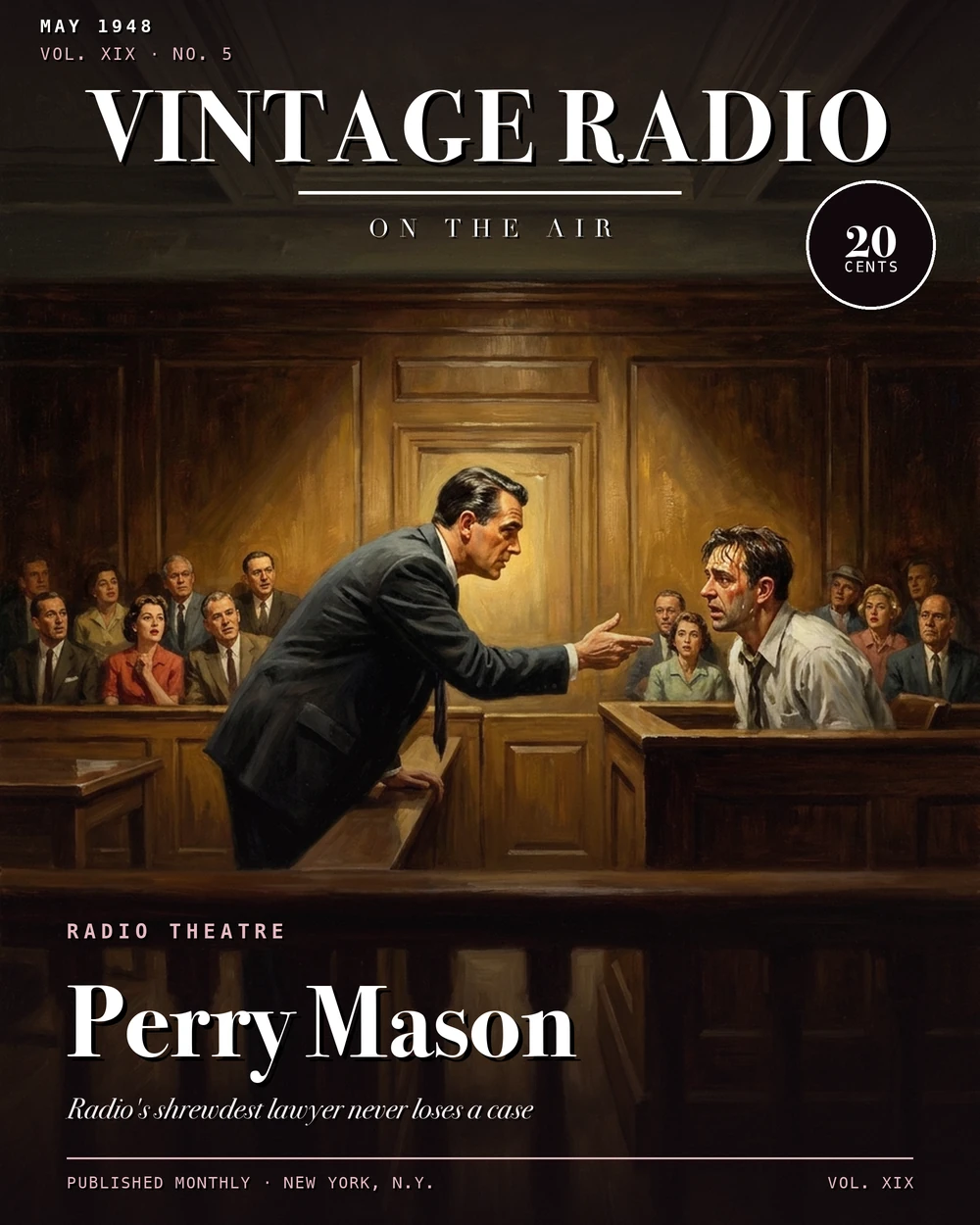
Perry Mason
A Lawyer Who Didn't Always Stay in the Courtroom
The Perry Mason who showed up on CBS radio in October 1943 was a noticeably different figure from the one who made Erle Stanley Gardner famous in print. In the novels, Mason was a courtroom tactician, famous for dismantling witnesses and unmasking killers during cross-examination. On radio, he functioned as much like a detective as a lawyer — trading gunfire with criminals, running down leads with his investigator Paul Drake, and only occasionally landing the dramatic courtroom moment that defined the books. It was, by design, a soap opera format: 15-minute weekday episodes, five days a week in the afternoon, slotted between The Second Mrs. Burton and Lone Journey and aimed squarely at the daytime audience. Gardner himself recognized the tension. He wrote the first few radio scripts at his Temecula ranch, then admitted frankly, "As a soaper, I stunk."
That admission captures something real about the show's complicated early years. Gardner had published around twenty successful Perry Mason novels by 1943 when he signed his contract with Procter & Gamble — and what P&G wanted was a daytime serial, not a condensed legal drama. The 15-minute structure demanded continuing storylines, recurring supporting characters, and the kind of emotional momentum that kept housewives tuned in across a week's worth of episodes. Gardner's courtroom chess games didn't translate easily to that rhythm. After some fitful early episodes, he handed off writing duties to staff writers, collecting royalties on every episode for the rest of the run without writing the bulk of the scripts.
The Cast and How It Settled
The show went through leading men at a brisk pace in its first three years. Bartlett Robinson originated the role at the 1943 premiere, with Santos Ortega and Donald Briggs each taking turns through the mid-1940s. The revolving door stopped on March 31, 1947, when John Larkin stepped in and held the part through the final broadcast on December 30, 1955. Larkin's steady tenure gave the show a center it had lacked earlier, and his voice became the one most listeners associated with Mason for the bulk of the run.
Della Street, Mason's faithful secretary, went through her own succession. Gertrude Warner came first, followed by Jan Miner and Joan Alexander — both of whom built careers that would far outlast the show. Miner became a fixture in American households as "Madge" in the long-running Palmolive dishwashing liquid commercials. Alexander had already voiced the lovely Margot Lane opposite Orson Welles on The Shadow and played the title role on Joyce Jordan, M.D. Paul Drake was handled at various points by Matt Crowley and Chuck Webster, while Mandel Kramer and Frank Dane took turns as Police Lieutenant Tragg. William Meeder provided the music on organ and piano — a sound very much of the daytime serial world.
Writer Irving Vendig deserves real credit for steadying the series. Around 1946, Vendig stepped in and significantly improved the scripts, and Gardner eventually came to tolerate — and then like — the radio version of his character. Carlo De Angelo directed from the 1943 premiere, with Art Hanna, Carl Eastman, Ralph Butler, and Hoyt Allen taking the helm at various later points. Announcers Alan Kent, Richard Stark, and Bob Dixon kept things moving across the run. Procter & Gamble held the sponsorship almost throughout, first for Tide and Camay from 1943 to 1955, with General Foods coming aboard briefly for the final stretch in mid-1955.
Where Perry Mason Came From
Gardner's connection to the law was not purely fictional. He was admitted to the California bar in 1911 and practiced criminal defense in Ventura before fiction took over. The name "Perry Mason" itself has an offbeat origin: Gardner borrowed it from the logo of the Youth's Companion, a magazine he read as a child that was published by the Perry Mason Company. The first novel, The Case of the Velvet Claws, appeared in March 1933, and Gardner eventually wrote 82 novels and short story collections featuring the character. The Perry Mason book series ranks third among the best-selling book series of all time, with roughly 300 million copies sold.
Before the radio show, Warner Bros. had already produced six Perry Mason feature films between 1934 and 1937 — Warren William in the first four, Ricardo Cortez in the fifth, and Donald Woods in the sixth, The Case of the Stuttering Bishop. Gardner was dissatisfied with what Hollywood had done to his character and vowed to retain control over future adaptations. That vow shaped every negotiation that followed, including the contentious discussions with CBS that eventually ended the radio run and redirected the property toward prime-time television.
The Soap Opera Problem — and Where It Led
By the mid-1950s, CBS was looking at moving Perry Mason to daytime television. The network's concept included giving Mason a romantic love interest, something Gardner flatly refused. He withdrew his support, which forced CBS to change the character's name and build a new show around the format. Procter & Gamble hired Irving Vendig — the writer who had saved the radio series — to retool the concept. The result was The Edge of Night, which premiered on CBS on April 2, 1956, with a character named Mike Karr as a thinly veiled Perry Mason substitute. John Larkin, who had played Mason on radio for eight years, originated the role of Mike Karr and held it until October 1961. The Edge of Night ran for 7,420 episodes across CBS and ABC through 1984 — an extraordinary run, with its roots directly in the radio Perry Mason's afternoon serial DNA.
In its first year alone, The Edge of Night drew an audience of nine million, in part because the public perceived it as a continuation of what they had been hearing on radio. Historians have noted that radio's Perry Mason has more in common with The Edge of Night than with the prime-time television series that came later — which is a useful way to understand what the radio show actually was. It was always closer to a soap opera than a courtroom drama, whatever its title implied.
The Show That Ran Alongside It
After Gardner withdrew from the daytime TV proposal, CBS came back with a different offer: a prime-time series that would stick much closer to his original courtroom vision. Perry Mason debuted in prime time in September 1957 with Raymond Burr in the title role, and that series ran on CBS through 1966, becoming a black-and-white television classic with powerful ratings. Burr had originally auditioned to play district attorney Hamilton Burger; it was Gardner himself, watching Burr's screen test, who decided he'd found his Perry Mason.
Both Bartlett Robinson and John Larkin later appeared as guest players in episodes of the Burr television series, a small acknowledgment of the show's lineage. Robinson, who had launched the radio version at the 1943 premiere, lived until 1986; Larkin, who carried the radio version through its final eight years, died in 1965, just a few years after leaving The Edge of Night.
The radio series itself produced over 3,000 episodes across its 12-year run — five episodes a week, week after week, for more than a decade, with continuing storylines and a revolving cast working through scripts Gardner mostly didn't write but continued to profit from. The recurring figures of Helen and Jake Jacobson, two news reporters who helped Mason fool suspects and the prosecution, are the kind of detail that separates a long-running serial from a simple anthology — invented characters built to serve the ongoing world the radio version had to construct around Gardner's already-famous lawyer. Guest appearances from the likes of Mercedes McCambridge suggest the talent the show could attract along the way. By any measure, it was a substantial piece of radio history — just a different Perry Mason than the one most people think of when they hear the name.